4Front ProAudio VST/VSTi





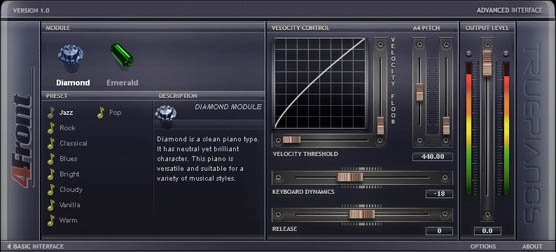
| 4FRONT TruePianos TruePianos is a new virtual piano VSTi based on a combination of physical modeling, synthesis and sampler techniques. Using a combination of the best what these individual technologies have to offer, TruePianos provides great playability by allowing itself to be easily adjusted to the combination of your unique playing style and the specific characteristics of your MIDI keyboard, instead of the other way around. It doesn't attempt to meticulously simulate existing pianos but instead provides realistic and expressive range of piano modules, each with individual dry sounding presets that you 'just play'. |
||
The Vacation -la Vacanza- - Tinto Brass 1971 -s... ((install))(released internationally as The Vacation ) is a critically acclaimed 1971 Italian drama film directed by avant-garde filmmaker Tinto Brass . The film stars Vanessa Redgrave and Franco Nero , delivering a stinging critique of societal hypocrisy, capitalism, and mental health institutions . It premiered at the 32nd Venice International Film Festival on September 4, 1971, winning the prestigious Pasinetti Award for Best Italian Film . Long before Brass became famous for erotic cinema, this arthouse gem stood out as a brilliant political satire. Key Film Specifications Throughout his career, Brass has been accused of sexism, misogyny, and even fascism, largely due to his depiction of strong female characters and exploration of themes considered taboo at the time. While these criticisms are undoubtedly valid, they also highlight Brass's unwavering commitment to challenging societal norms and pushing the boundaries of cinematic storytelling. Dive deeper into the . At its core, "The Vacation" is a film about the disintegration of social norms and the eruption of repressed desires. The characters' carefree facade serves as a metaphor for the stifling conventions of Italian middle-class society in the early 1970s. As the group's behavior becomes increasingly erratic and transgressive, Brass cleverly exposes the hypocrisy and artificiality of their social constructs. The Vacation -La Vacanza- - Tinto Brass 1971 -S... Upon its premiere at the Venice Film Festival on September 4, 1971, La Vacanza caused a sensation, though not necessarily for the reasons its makers might have hoped. According to contemporary accounts, the screening nearly provoked a riot. The film’s anarchic politics, its unconventional narrative structure, and its unflinching depiction of social injustice clearly struck a nerve with the festival audience. La Vacanza was his thesis: The bourgeoisie does not need to be overthrown from the outside. It will implode from its own sexual and emotional impotence. The “vacation” is a metaphor for the false promise of consumer freedom. You can drive a fast car and wear expensive sunglasses, but if your soul is dead, you are already a ghost. The narrative follows , a vulnerable young peasant woman who has been unjustly committed to a psychiatric asylum. Her "crime" was not mental illness, but rather becoming an inconvenience: she was the mistress of a local Count who had her institutionalized so he could return to his wife without scandal. (released internationally as The Vacation ) is a Fleeing her family, Immacolata embarks on a surreal journey across the countryside. She crosses paths with , a rugged, free-spirited birdcatcher and poacher. Bonded by their shared status as societal outcasts, the two form an intense emotional connection. Through fluid, dreamlike flashbacks, Immacolata explains the past trauma and class-based hypocrisies that originally led to her institutionalization. 🎨 Themes and Cinematic Style 1. Anti-Psychiatry and Institutional Critique This public link is valid for 7 days and shares a thread, including any personal information you added. This link or copies made by others cannot be deleted. If you share with third parties, their policies apply. Can’t copy the link right now. Try again later. The Vacation is profoundly a film of its time. The revolutionary fervor of the late 1960s had given way to the early 1970s’ hangover. What happens when all social rules have been questioned, but nothing new has been built? Long before Brass became famous for erotic cinema, For viewers who know Tinto Brass only from his later erotic films, La Vacanza comes as a revelation. Gone are the abundant nudity, the fetishistic rear-end shots, and the softcore tableaux. Instead, what remains is a director working at the height of his formal powers, channeling a dizzying array of influences into a style that is at once experimental, political, and deeply humane. The Vacation (La Vacanza) - Tinto Brass (1971): A Surreal Journey into 1970s Italian Counter-Culture Despite winning critical acclaim at Venice, La vacanza suffered from limited distribution and poor preservation. For decades, the film was primarily accessible via low-quality Italian VHS rips or obscure digital bootlegs, often miscategorized under Brass's later erotic filmography. For decades, La Vacanza remained a legendary "lost film" of Italian cinema. Due to its highly provocative nature and distribution roadblocks, it was primarily available only on degraded 1990s Italian VHS tapes or underground bootleg circles. However, as the days pass, the veneer of civility begins to crack, revealing the group's underlying tensions, insecurities, and repressed desires. The friends' interactions become increasingly confrontational, with long-buried conflicts and jealousies simmering to the surface. As the group's dynamics deteriorate, they find themselves embroiled in a series of absurd, humorous, and occasionally disturbing events. |
||
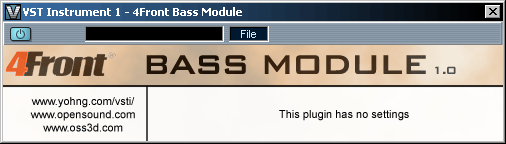
| 4FRONT BASS MODULE (VSTi) The bass module is a morph between sample playback and a synthesizer. Original string excitation is sampled, and then sound is modeled. Playing chords will add extra fat rumble, like when playing a real bass guitar. Bass guitar range was artifically extended up and down, so that higher notes and parts can be played as well. |
||
|
4FRONT RHODE MODULE (VSTi)
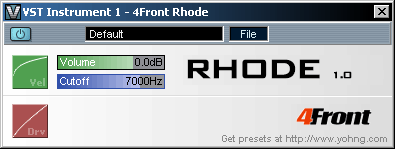
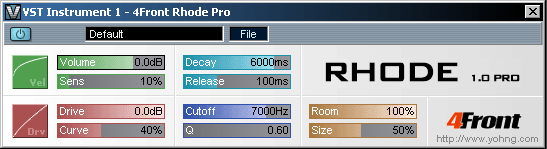
A vintage Rhodes/Wurly typed piano module with gentle overdrive. This module reproduces the classic sound similar to Rhodes/Wurlitzer pianos. Module is not sample based, and the sound is generated on-the-fly, therefore there are no sampling layer switches - vintage rhodes overdrive is smooth, clean and continuous. Difference between Basic (free) and Pro (commercial) modules To get a common idea of what exactly is different, check the screenshots below: Basic version:
As you can see, basic version is generally lacking envelope, sensitivity/drive and room controls, that Pro version has. If you like to get this kind of controlling over 4Front Rhode sound, you may want to get Pro version. MP3 Demos |
||
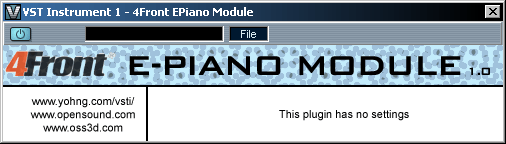
| 4FRONT E-PIANO MODULE (VSTi) E-Piano module with a rich, warm and silky sound. It is quite unique by its character. The module is made with a hybrid technology, which involves sample playback and synthesizing within one case. For its quality, module has reasonable small size. |
||
|
4Front XLimiter (VST/DX)
A gentle and soft brickwall limiter processor. Primary design goals: - Master track brickwall compression - Vocal track compression - Solo track compression A special multistage algorithm provides a very soft transition envelope, thus rapid level changes at extreme Threshold level will not pump or distort as much as with the other processors. The limiter employs best properties of a single band processor, whereas additional techniques are used to provide advantages of "continuous multiband" processing. Usage: With the default settings it will limit the signal at 0dB. This is useful to plug into the master effect bin of a multitrack software. You can lower Threshold value to bring up the volume of the track. If you are limiting a vocal track - you can also set appropriate ceiling value to control the output volume. If you have deessing or disturbing frequencies problem, try using this effect as a vocal or solo processor. In most cases you will not need an additional de-essing, as XLimiter will handle those transients properly. 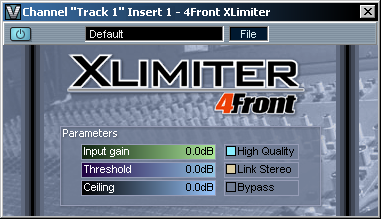 |
||
|
4FRONT AUXITER (VST/DX)
This is a high frequency refresher exciter-type plugin. It brings clarity to the high end by regenerating high frequency harmonics. Primary design goals: - Vocal enhancer - Per/track enhancer - Master track restoration/refreshment - Old tracks restoration Usage: First try to figure right Frequency slider value for your track, then control the Harmonic, Drive and Mix levels to get the best enhancement. 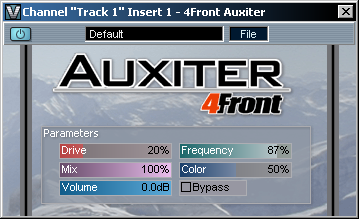 |
||
| 4FRONT SAND BRUSH (VST/DX) The plugin completely regenerates high frequencies, basing on the existing partials. The plugin can be used to apply on hihats and other percussive sounds with high frequency content, and also can be used on other tracks to add "sand". Depending on the settings, plugin can be also used to emulate the vintage vinyl sound. Primary design goals: - Sand for vocal and solo tracks - Bring life back to sampled strings - Track restoration (including MP3) - Vintage effect (to create vintage sound) The plugin contains multiple presets for various track types. 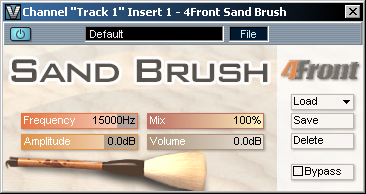 |
||
| 4FRONT CONTOUR MAX (VST/DX) The plugin is designed to change the basic frequency contour of a sound track, or the overall frequency balance of a master. Primary design goals: - Master processing - Per-track processing for balancing low and high end - Track restoration The plugin contains multiple presets for various track types. 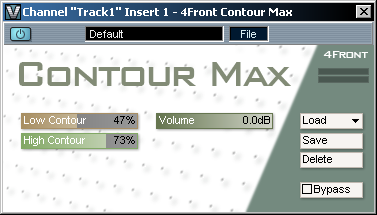 |